How to use Facebook to push your business.

or... how to sell pizza in Wisconsin.  Click the link, it's real!

UPDATE 2/22/10 5:27 PM EST:  Let me give a hat tip to Rob Bellin for posting the link below on his facebook account.  Also, just to be clear, I support both the business and political aspects of this markering campaign.  I don't think the owners of "Ians Pizza" are cynically taking advantage of the situation, I just think that they are taking advantage of it.  And here's to that!

http://www.facebook.com/IansPizzaOnState
Monday, February 21 (12:15pm)

Thank you all so much for visiting!

If you are here to learn how help feed the protesters in Madison, here's how you can do that:

Call us at 608-257-9248, then press 1. As we have just three phone lines it may take a while to get through, and we apologize in advance for that.

For online ordering we have partnered with both badgerbites.com andcampusfood.com to process our online orders. If you would like to order online, please put 115 State Street as the delivery address, and add in the notes that you would like to help feed the protesters.

While we thought about it, we will not be setting up a Paypal account, even though we realize that would make it easier. Please understand it's not because we don't want to help you out; we really just don't want to over-promise & under-deliver.

It's important to us as a business and as individuals that if we say we are taking your hard-earned money to help feed supporters, that we will make sure that happens. By taking phone calls and online orders only we can ensure that the money you spend with us does indeed get made into pizza that goes to the capital.

We truly appreciate all the enthusiasm, and know that many of you want to help feed the protesters, but we are also just one small business. Believe us when we say we are not really accustomed to getting pizza orders from the entire country (let alone internationally!)

Thank you for your understanding!

What's this really about?

Ezra, nails it. If you've been following Wisconsin, then you need the perspective below. It's not about budget deficits, it's about power.

Scott Walker should be seen as the face of the modern GOP.


Column: Wisconsin is about power, not money:
from Ezra Klein

"You've probably heard politicians fret that state governments - or, worse, the federal government - will default on their debts. House Speaker John A. Boehner called the prospect of a federal default 'a financial disaster not only for our country, but for the worldwide economy.' Nasty stuff.


But it's worth asking why a default would such a problem. Can't we just launch a missile at our creditors, or promise to do better next time? Well, no. Our creditors have power over us. If the actors who make up the entity we loosely refer to as 'the market' - that means everyone from banks to hedge funds to China - don't get paid back, they'll go nuts. They'll realize we're fiscally irresponsible. They'll stop lending us money, or at least start charging us more when they do. Interest rates will skyrocket, and the economy will grind to a halt.


So America's various governmental entities are looking for ways to avoid defaulting on their debt - or at least defaulting on their debt to the powerful. That addendum is important, because one of the strategies that's emerging is to default on debt to the less powerful, the people who don't have the power to wreck our economy.


This is a crucial fact about the economy, and one often underplayed by economists: power matters. It's worth more, in many cases, than money. And that's what's really at issue in Wisconsin. It's why Gov. Scott Walker is uninterested in taking concessions from the unions on wages and benefits if they don't come alongside concessions on collective bargaining. What he wants isn't a change in the balance of payments. It's a change in the balance of power.

The deal Wisconsin made with its state employees was simple: Accept lower wages than you could get in the private sector now in return for better pensions and health-care benefits when you retire. Now Walker wants to renege on that deal.


Rather than stiff the banks, in other words, he wants to stiff the teachers - but the crucial twist he's added, the one that's sent tens of thousands of workers into the streets, is that he wants to make sure they can't fight back once he does it.


The reason you can't stiff bondholders is that they can make a state or country regret reneging on the deals they've made. They can increase borrowing costs far into the future, slowing economic growth and, through the resulting economic pain, throwing politicians out of office. That gives them power. An ordinary teacher does not have access to such artillery. Unless, of course, she's part of a union.


Unions - through collective bargaining, strikes and other means - give workers power. They make reneging on contracts with their members painful. They also make negotiations less lopsided.


They're not perfect, of course. They sometimes negotiate bad deals, or misbehave, or hand good money over to bad people, or put their short-term interests ahead of the public's long-term interests. But then, so do corporations and politicians.


But their power matters for more than just debt repayment. For all their faults, unions tend to see their constituents as not just their own members, but the 'working class,' broadly defined. That's why you'll find labor's fingerprints on everything from the two-day weekend to Medicare to the Civil Rights Act of 1965 - none of which require you to flash a union card before you can benefit from them. They act -- quite self-consciously -- as a counterbalance to corporate power. There's no reason, after all, that unions should be leading the fight to see the Bush tax cuts for the wealthy expire. That's political capital they could be spending on reform of the nation's labor laws. And yet they are.


To get a sense of what a world without unions would look like - a world where power is distributed radically differently - you need look no further than Walker's own proposals. In his State of the State speech, he said, 'The decisions we face are not easy and the solutions we must approve will require true sacrifice.' He's already called for plenty of it from not only state employees, but also the low-income residents who rely on Wisconsin's BadgerCare program.


But some won't have to sacrifice nearly so much. Walker's campaign platform called for sharp cuts in corporate taxes, including 'eliminating corporate taxes for the first two years of operation.' His budget repair bill proposes to allow the state to sell energy plants 'with or without solicitation of bids, for any amount that the department determines to be in the best interest of the state,' and goes on to say that 'any such purchase is considered to be in the public interest.'


What you're seeing there isn't necessarily a world where deficits are lower. Rather, it's a world where power is distributed very differently. You can argue that that's a good thing, though I'm skeptical. But let's not confuse a discussion over political power with a discussion over deficits."

As Brad DeLong would say...

Friends don't let friends vote Republican.


The Less Discussed Part of Walker’s Wisconsin Plan: No-Bid Energy Assets Firesales.: "

Mike Konczal is a fellow with the Roosevelt Institute, and is a blogger at the Rortybomb Blog and New Deal 2.0.


Originally posted here


~~~

Have you heard about 16.896?


The fight in Wisconsin is over Governor Walker’s 144-page Budget Repair Bill. The parts everyone is focusing on have to do with the right to collectively bargain being stripped from public sector unions (except for the unions that supported Walker running for Governor). Focusing on this misses a large part of what the bill would do. Check out this language, from the same bill (my bold):


16.896 Sale or contractual operation of state−owned heating, cooling, and power plants. (1) Notwithstanding ss. 13.48 (14) (am) and 16.705 (1), the department may sell any state−owned heating, cooling, and power plant or may contract with a private entity for the operation of any such plant, with or without solicitation of bids, for any amount that the department determines to be in the best interest of the state. Notwithstanding ss. 196.49 and 196.80, no approval or certification of the public service commission is necessary for a public utility to purchase, or contract for the operation of, such a plant, and any such purchase is considered to be in the public interest and to comply with the criteria for certification of a project under s. 196.49 (3) (b).


The bill would allow for the selling of state-owned heating/cooling/power plants without bids and without concern for the legally-defined public interest. This excellent catch is from Ed at ginandtacos.com (who, speaking of Madison, took me to the Essen Haus on my 21st birthday, where the night began to go sideways). Ed correctly notes:


If this isn’t the best summary of the goals of modern conservatism, I don’t know what is. It’s like a highlight reel of all of the tomahawk dunks of neo-Gilded Age corporatism: privatization, no-bid contracts, deregulation, and naked cronyism. Extra bonus points for the explicit effort to legally redefine the term “public interest” as “whatever the energy industry lobbyists we appoint to these unelected bureaucratic positions say it is.”


In case it isn’t clear where the naked cronyism comes in, remember which large, politically active private interest loves buying up power plants and already has considerable interests in Wisconsin. Then consider their demonstrated eagerness to help Mr. Walker get elected and bus in carpetbaggers to have a sad little pro-Mubarak style “rally” in his honor. There are dots to be connected here, but doing so might not be in the public interest.


It’s important to think of this battle as a larger one over the role of the state. The attempt to break labor is part of the same continuous motion as saying that the crony, corporatist selling of state utilities to the Koch brothers and other energy interests is the new “public interest.”"

Wisconsin

The more I hear about Wisconsin, the more it makes me angry. Kevin Drum finds yet another way for my anger to find focus.

As an aside, why do we think it helps the country to screw over teachers? I'll never get this.

Defunding the Democratic Party:
from Kevin Drum
"Wisconsin, the birthplace of public sector unions, is now ground zero for the Republican jihad to destroy them, with a GOP-sponsored bill to strip Wisconsin's public unions of their collective bargaining rights now seemingly certain to pass. The cynicism of the bill might not be entirely clear until you hear the details:


[The bill] would require most public workers to pay half their pension costs — typically 5.8% of pay for state workers — and at least 12% of their health care costs. It applies to most state and local employees but does not apply to police, firefighters and state troopers, who would continue to bargain for their benefits.


Except for police, firefighters and troopers, raises would be limited to inflation unless a bigger increase was approved in a referendum. The non-law enforcement unions would lose their rights to bargain over anything but wages, would have to hold annual elections to keep their organizations intact and would lose the ability to have union dues deducted from state paychecks.


Now why would this be? Is it because collective bargaining is somehow less of a problem for public safety employees than for teachers? Because strikes by cops are less hazardous than strikes by teachers? Because public safety employees tend not to be hard bargainers anyway? Because public safety employees are poorly paid?


Or is it because teachers tend to vote pretty reliably for Democrats and public safety employees don't? Bingo.


The irony here is that when you hear those cherry-picked horror stories of vastly overpaid civil servants (usually the result of overtime abuse of some kind), nine times out of ten it involves a public safety employee. It's not teachers who get to retire at age 50 and it's not teachers who end up padding their hours in their last year of work and retiring on 120% of their usual income. Most of the time, it's police, firefighters, and state troopers.


But they're the ones exempt from the Wisconsin GOP's union bashing drive. Go figure."

Fear

You've seen all the polls that show how Americans don't want government spending cut on their favorite programs (which seems like all of them when the questions are asked). In the back of my mind that's always there, like a great card you're just waiting for the right opportunity to play. Let the GOP go all cut crazy; in the end, everybody will wake-up, realized what's happening and then we can fix this nonsense. That's what's been in my head anyway. Probably like a 90% confidence factor.

This cuts through my crap. I shouldn't be so confident.


Chris Christie on Budget Cuts and Electability:
from Weigel

"Chris Christie's speech at AEI yesterday was a compelling little sidebar to the scene in Wisconsin, where a governor working on the Christie model is getting a harsh and immediate confrontation with public sector unions. I'm always struck by how much Christie goes meta and talks about his own popularity -- something Republicans have been paying a lot of attention to. Here's the bluntest that Christie got:

I said to those firefighters you may hate me now but 15 years from now when you have a pension to collect because of what I did you'll be looking for my address on the internet so you can send me a thank you note.

But he also got more specific about his own polling than pols usually get, in public.

I was elected with 49% of the vote, in a three way race in November of 2009. The first Republican elected to statewide office in 12 years in New Jersey, but not with a majority. 49% of the vote and when I started to say we were going to cut k-12 education funding by more than a billion dollars, we're going to cut municipal aid by more than half a billion dollars, we're going to cut every program that we can find in
government and balance without raising taxes. I had everybody telling me, Governor you can't do it. Your approval ratings will go in the toilet. People love these programs... 

And what's happened? After 13 months of fighting and arguing and pushing and impatience, my approval rating's at 54%. No disaster, in fact, more popular today than the day I was elected and that's in a state that is as Democratic as any state in America for a Republican governor. But if you really want to see eye-popping numbers, look across the river. At the person who was recently characterized as my soul mate -- I wonder how he feels about that! Governor Andrew Cuomo, in a poll that just came out 2 days ago, his job approval is at 77%, 77%. And all he's talked about is cutting spending, not raising taxes, addressing entitlement programs, Medicaid, pensions, taking on public sector unions, capping superintendent pay, the hard things. The things that people tell you will lead to political ruin, they don't.

Thus why Republicans are confident they can cut everything, and Democrats are underestimating them."

Paul Ryan is not my favorite politician

The more I read about Ryan, the more obnoxious I find him. And yet he becomes more and more prominent in the GOP. His claim to fame is 'seriousness about cutting budget deficits'. But he's obviously a fraud on this topic. Here's more expose from Jonathan Chait.


Paul Ryan Keeps Attacking Obama For Opposing Ryan-Opposed Plan:
from Jonathan Chait
"Paul Ryan isn't letting go of his Obama-ignored-the-deficit-commission talking point. Here's his interview with Politico's Mike Allen.

Ryan: President Obama, through an executive order, created his own commission to solve this plan.

Q: You were on it.

Ryan: I was on the commission. And you know what he did? He didn't accept -- he didn't take one of the big recommendations of the commission, he basically disavowed the commission. And now, after the commission said we have an economic ruin on our hands, he put out a budget that said, that Erskine Bowles, the Democrat-appointed chairman of the commission says, doesn't go anywhere near where we have to go to solve our fiscal nightmare.

Q: So, do you think the commission was worth having?

Ryan: I thought it was great worth having [sic]. I thought it advanced an adult conversation that we needed to have. But the president just took us a few steps backwards by ignoring the commissions' findings, by ignoring its conclusions. It was mostly Democrats on the commission, which came from his point of view, and [shaking head] he didn't even take the recommendations.

You know what a good follow-up question would be? "So, Paul Ryan you voted against the commission's proposals! How can you attack Obama for failing to endorse policies you voted against?"

Here was Allen's actual follow up question:

Q: Mr. Chairman, you've been talking about entitlements about as long as I've known you. Based on the outreach you've gotten from the the White House in the past, how sincere do you think their current comments about this are?


Guess what? Ryan decided the White House isn't very sincere.

In many ways, this interview was very typical of Ryan's fawning press coverage. The reporter took as a given Ryan's premises that the national debt is our greatest crisis, that "leadership" is synonymous with cutting entitlement programs (and that raising taxes is not "leadership," and that the Bowles-Simpson commission represents the epitome of sound public policy. Now, I disagree with all these premises, but put that aside.

Even by these premises, which are often accepted uncritically within the media, Ryan is not a fiscal hawk. He voted for George W. Bush's 100% debt-financed Medicare expansion. He voted against the Bowles-Simpson plan. Isn't his authority on these issues just a wee bit suspect? Why do the media not only fail to question his sincerity at all, but give him an uncritical platform to question the sincerity of others? It's bizarre."

Social Security is not the problem...

Robert Reich points out that the 'problem' with social security is part of the same trend-line that's been affecting our society for the past three decades. Growing income inequality.


Budget Baloney (1): Why Social Security Isn't a Problem, and the Best Way to Fix the Small Piece of It That Needs Fixing:
from Robert Reich
"New Jersey Governor Chris Christie, a Republican presidential hopeful, says in order to “save” Social Security the retirement age should be raised. The media are congratulating him for his putative “courage.” Deficit hawks are proclaiming Social Security one of the big entitlements that has to be cut in order to reduce the budget deficit.

This is all baloney.


In a former life I was a trustee of the Social Security trust fund. So let me set the record straight.


Social Security isn’t responsible for the federal deficit. Just the opposite. Until last year Social Security took in more payroll taxes than it paid out in benefits. It lent the surpluses to the rest of the government.


Now that Social Security has started to pay out more than it takes in, Social Security can simply collect what the rest of the government owes it. This will keep it fully solvent for the next 26 years.


But why should there even be a problem 26 years from now? Back in 1983, Alan Greenspan’s Social Security commission was supposed to have fixed the system for good – by gradually increasing payroll taxes and raising the retirement age. (Early boomers like me can start collecting full benefits at age 66; late boomers born after 1960 will have to wait until they’re 67.)


Greenspan’s commission must have failed to predict something. But what? It fairly accurately predicted how quickly the boomers would age. It had a pretty good idea of how fast the US economy would grow. While it underestimated how many immigrants would be coming into the United States, that’s no problem. To the contrary, most new immigrants are young and their payroll-tax contributions will far exceed what they draw from Social Security for decades.


So what did Greenspan’s commission fail to see coming?


Inequality.


Remember, the Social Security payroll tax applies only to earnings up to a certain ceiling. (That ceiling is now $106,800.) The ceiling rises every year according to a formula roughly matching inflation.


Back in 1983, the ceiling was set so the Social Security payroll tax would hit 90 percent of all wages covered by Social Security. That 90 percent figure was built into the Greenspan Commission’s predictions. The Commission assumed that, as the ceiling rose with inflation, the Social Security payroll tax would continue to hit 90 percent of total income.


Today, though, the Social Security payroll tax hits only about 84 percent of total income.


The reason it went from 90 percent to 84 percent is a larger and larger portion of total income has gone to the top. In 1983, the richest 1 percent of Americans got 11.6 percent of total income. Today the top 1 percent takes in more than 20 percent.


If we want to go back to 90 percent, the ceiling on income subject to the Social Security tax would need to be raised to $180,000.


Presto. Social Security’s long-term (beyond 26 years from now) problem would be solved.


So there’s no reason to even consider reducing Social Security benefits or raising the age of eligibility. The logical response to the increasing concentration of income at the top is simply to raise the ceiling.


Not incidentally, several months ago the White House considered proposing that the ceiling be lifted to $180,000. Somehow, though, that proposal didn’t make it into the President’s budget."

Don't worry, they'll stay...

I hear the argument that "You can't raise state (local) taxes on the rich, because if you do they'll just leave. What good is that?" It's basically an anti-tax talking point. And why, not? It's pretty persuasive.

Below is evidence that suggests rich people haven't actually left when their taxes were increased.


Tax-Flight Arguments (Still) Don’t Add Up:
"Two governors are proposing this week to raise taxes on their state’s wealthiest residents. Today, Minnesota’s Mark Dayton proposed higher income tax rates on taxable incomes above $150,000 and a surtax on incomes over $500,000; tomorrow, Connecticut’s Daniel P. Malloy is expected to propose a higher rate on incomes over $1 million.

Some critics will surely claim, as they have in other states, that higher-income people will flee from the state. No such flight has occurred in other states that raised top rates, but that won’t stop these attacks, as some recent examples show:

  • A Bloomberg News story headlined “New Jersey Population Growth Slows as Taxes Push Some to Flee” noted that the Garden State’s population grew much more slowly between 2000 and 2010 than most other states. It suggested that New Jersey’s top income tax rate — now 8.97 percent — was to blame.
    But the 8.97 percent rate affects only a tiny share of New Jersey filers — the 1.2 percent with taxable incomes over $500,000 — and those folks aren’t leaving. Quite the contrary, there’s strong population growth within that bracket: during roughly the same time period (1999-2008), the number of New Jersey filers with incomes over $500,000 grew by more than two-thirds.

    As two Princeton University researchers, Cristobal Young and Charles Varner, conclude in a new report on a 2004 measure that set the 8.97 percent rate: “While in principle it is easier for tax avoiders to migrate out of state than out of country, the reluctance of people to do so gives states significant room to tax top incomes. Indeed, we estimate that New Jersey’s new tax raises nearly $1 billion per year, and tangibly reduces income inequality, with little cost in terms of tax flight.”

  • A Connecticut Policy Institute report contends the state’s top income tax rate of 6.5 percent is causing residents to flee. But as Robert Frank pointed out in the Wall Street Journal, the state’s population of top-income households is growing, not shrinking (as in New Jersey). And many of those who leave go to New York, where tax rates are higher.

  • An Ocean State Policy Research Institute report claims that Rhode Island’s estate tax (which applies to estates worth more than about $850,000) is the main driver of out-migration from the state. But the report’s spurious reasoning earned it a “false” rating from PolitiFact Rhode Island and a stinging rebuttal from The Poverty Institute of Rhode Island. Among other problems, the study argues that many residents are fleeing Rhode Island for Florida because the latter lacks an estate tax, even though the number of migrating residents actually fell in the years after Florida eliminated its estate tax.

States are addressing huge, recession-induced revenue shortfalls by cutting everything from kindergarten funding to services for Alzheimer’s patients — and more deep cuts are on the way. Policymakers should ask those who can best afford it to pay somewhat more, solid in the knowledge — and despite assertions to the contrary — that they won’t flee from higher income taxes. In short, policymakers should base taxes on the cost of meeting real needs, not on unfounded fears."

Propaganda rules....

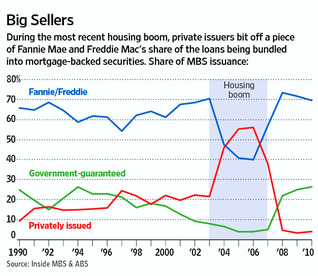
As you continue to hear that Fannie and Freddie caused the crisis, remember, it's partisan nonsense.


Fannie/Freddie Market Share Plummeted During Boom:
from The Big Picture
"You may have missed Matt Phillips massive read Friday afternoon on the GSEs in the WSJ blog Marketbeat.

The entire piece is definitely worth your time, but I found one chart especially compelling: It shows Fannie & Freddie’s market share plummeting from over 70% to under 40%, as Wall Street securitized all manner of non-conforming mortgages:


There is no way to reconcile this chart with the jihadist blatherings of folks like AEI and CATO.

The facts of the matter are simply this: During the housing boom, it was Wall Street, and their mad purchases of Sub-Prime, Alt A and non conforming loans for their privately issued securitization that drove the credit bubble. Not, as the ideologically blinded Peter Wallison claims, Fannie & Freddie.

Class dismissed."

Cuts are not about the deficit...

A second must read post from Jonathan Bernstein today. He's on a roll.


A Plea For Plain Language on Deficits:
from A plain blog about politics
"The long term budget deficit is about one thing: medical costs. It's not about 'entitlements.' Social Security isn't a long run problem of any serious consequence, nor are various small programs that count as entitlements in the budget process. Long-term projections of the federal budget are very clear. It's all about health care.

Medical costs. Medical costs are going up much faster than inflation. Therefore, Medicare and Medicaid, and any other government programs affected by medical costs, will, long term, get far more expensive than any realistic level of taxation can handle.

So when budget hawks talk about 'entitlements,' as Andrew Sullivan did today, they're using language that in my view obscures, rather than illuminates, the situation.

Now, I'd go a bit further, as others have done. I agree with those who have argued that health care isn't really, properly speaking, a federal budget problem. It's a serious problem for the American economy. Thinking of it as a budget deficit problem misses the point; shut down Medicare completely and you solve the budget deficit part of it, but you still have an important dysfunctional situation with regard to health care.

Either way, I agree with Jonathan Chait: the way to measure a politician on federal budget deficits is really just to measure whether he or she has made medical costs a priority.

Now, and here's the part in which I give me own views of these things, I'll admit that I simply don't buy the idea that budget deficits have something to do with the future (it's not as if all those under-30s who voted for Obama are going to have to pay back the deficits when they 'come due' down the line -- but they are among those who are badly hurt by a recession-level employment situation, which in my view could have been alleviated with more deficit spending over the last few years). That's a policy opinion, and others may and do disagree.

But as far as talking about budget deficits, there's really no question about it. It's health care costs. Most of the rest of what people are talking about is either stuff around the margins (important! -- government should be run properly! -- but it's not going to change the long-term deficit situation), or is about the preferred size or functions of government, not about deficits at all (well, there's the conservative position, which I interpret as pro-deficit, but that's a slightly different issue).

Getting back to my main point...in my view, those who are upset about the long-term federal budget deficit should talk about it in terms of what it is, health care costs. Just as the phrase 'weapons of mass destruction' encourages sloppy thinking (because nuclear weapons are not really similar at all to chemical and biological weapons in lots of important ways), talking about 'entitlements' confuses the budget situation. I could see 'Medicare and Medicaid' or, perhaps, 'government health programs,' but not entitlements."

The budget proposal is a starting line...

Hopefully the finish line isn't a government shut-down.

Yes, The President's Budget Matters:
from A plain blog about politics
"I've seen a fair number of people today complaining that, given the election results last fall, the publication of this year's budget by the White House is more rhetoric and campaign positioning than it is actual policy-making. You hear the word 'kabuki' a lot.

I disagree! Obviously the president won't get what he wants from Congress. But the budget is an important statement of 'what he wants.' It's true that it's tailored for the budget wars, so it's not an indication of what Barack Obama would want in a world in which he has all the choices, but it does signal, over and over again, which programs he's going to fight for and which he's not, what the overall budget strategy he'll fight for will be, and, worth less but still not useless, on what terms and even what language he's going to use to fight for those things.

So, while he's not going to win all of those fights outright, it surely matters to recipients of Pell Grants, for example, what Obama's position is going to be this year.

Some links...the president's budget. The New York Times budget graphic (nice). Budget junkie Stan Collender has an ode to digital budgets that really applies to, well, everything in politics. Several good posts from Ezra Klein today...I'll link to this one, but read 'em all. And a short budget process primer for beginners that I did last year -- or if you want a spiffier and not that much longer version, go to CBPP.
"

Yes, they missed it.

I'm a huge Gladwell fan, but Sullivan does a good job here explaining the subversive usefulness of Twitter and Facebook in the face of an autocratic regime.

Rich And Gladwell, Wallflowers At History: Tunisia:
from The Daily Dish | By Andrew Sullivan
"

FACEBOOKGRAFFITIPeterMacDiarmid_Getty


It must have been a little galling for Malcolm Gladwell to observe the revolutions in Tunisia and Egypt. In an atypically mediocre piece, Gladwell not so long ago denied the fact that Twitter or social media or cell-phones or Facebook had anything much to do with the Iranian Green Revolution. His point, such as it was, was that such things were never sufficient in and of themselves to create a revolution. They were weak connections not strong ones, and a revolution needed strong ones to endure. Well, as almost everyone but his editors noted at the time: duh.


Of course, strong connections like unions or political parties or churches or mosques and simply the courage of masses in the street are essential for revoltionary action. But this was true for decades - and yet the 1979 Revolution in Iran was indisputably galvanized by audio-tapes of Khomeini sermons smuggled in from abroad; and the 2009 Green Revolution was originally triggered by young people using Twitter and blogs and cellphone cameras to broadcast their numbers and outrage and courage. Then followed revolutions in Tunisia and Egypt, where the same technologies were deployed as weapons against the authorities.


Perhaps sensing the lameness of his point, Gladwell went online again to reiterate his point with respect to Egypt last week. Perhaps the best rejoinder was the following January 29 Onion headline:


Panicked Malcolm Gladwell Realizes Latest Theory Foretells End Of His Popularity


Then came another old media dinosaur, Frank Rich. Here's what he wrote only a week ago:


The talking-head invocations of Twitter and Facebook instead take the form of implicit, simplistic Western chauvinism. How fabulous that two great American digital innovations can rescue the downtrodden, unwashed masses. That is indeed impressive if no one points out that, even in the case of the young and relatively wired populace of Egypt, only some 20 percent of those masses have Internet access.


For Rich, reference to Facebook or Twitter and social media in the recent revolutions is a function of American parochialism, chauvinism or condescension! Hey, Mr Rich, check out the false consciousness among these US-brainwashed capitalist tools here:


Tumblr_lg3mzyOCZB1qz6z0no1_500


And let's look at the reality in Tunisia. Between one in ten and one in five Tunisians have a Facebook account - not that surprising when you consider that half the population is between 20 and 30, well educated, relatively secular and denied public forms of expression. In that revolution, the ability to upload videos of police brutality and post them on Facebook was central to why this time, the movement spread. In fact, it took off:


By January 8, Facebook says that it had several hundred thousand more users than it had ever had before in Tunisia, a country with a few more people than Michigan. Scaled up to the size to the U.S., the burst of activity was like adding 10 million users in a week. And the average time spent on the site more than doubled what it had been before.


Why on earth, according to Gladwell and Rich, would this happen if Facebook were irrelevant? The Facebook users kept one step ahead of the censors. Twitter helped keep dissidents in touch with the outside world when arrested:


Less than two weeks ago, Slim Amamou, a Tunisian blogger and activist, was using his @slim404 Twitter feed to let friends know that the police had been to his house. Later the same day, after he was arrested, the 33-year-old computer programmer managed to turn his phone on and log on to Google Latitude to broadcast his location: inside the country’s feared ministry of the interior.


Let's listen to a leader of the Tunisian revolution, Slim Amamou, now in the Tunisian government, explain how the Internet made a difference:


In 2008, there were uprisings in Redeyef, similar to what happened in Sidibouzid. But back then it seems that the internet community did not reach a critical mass. And then at that time, Facebook got censored for a week or two. I don't remember if it was related. But it was like a training for this revolution. People think that this revolution happened out of nowhere but we, on the Internet have been trying for years, together and all over the Arab world. The last campaign that mobilised people was for Khaled Said in Egypt, and we Tunisians participated. And you have to remember that Egyptians (and people all over the world) participated in the Tunisian revolution: they informed, they participated in Anonymous attacks and they even were the first to demonstrate for Sidibouzid in Cairo.


So, yes Internet was very important.


But what does he know from Tunisia, compared with Frank Rich on the Upper West Side?


(Photos: Peter MacDiarmid/Getty and Tumblr.)


Email this Article
Add to digg
Add to Reddit
Add to Twitter
Add to del.icio.us
Add to StumbleUpon
Add to Facebook


"

Can't imagine this blowing up in our face.

Great post on the dangers facing the country from a split GOP.

from A plain blog about politics


Not Getting Any Easier For Boehner: "I think Ezra Klein is correct in Wonkbook (which remains excellent, by the way -- anyone wanting to keep up with policy developments should really make it a daily must) about what really mattered in the House this week. It's how easily the leadership was rolled by the rank and file on spending:
This loss, much more than the failed votes on the extension of the PATRIOT Act or funds for the United Nations (both of which were brought to the floor under a rule requiring a 2/3rd majority for passage) shows that the House GOP leadership has little sway and less control over the rank-and-file. The Republican Study Committee seems more powerful than the Republican leadership at this point. The budget proposal produced by Rep. Jim Jordan won out over the one favored by Rep. Paul Ryan. If I were a betting man, I'd say the odds of a government shutdown -- either over cuts or the debt ceiling -- just went up dramatically.
Greg Sargent highlights the roll of outside organizations in enforcing budget-cutting orthodoxy among GOP Members of Congress, who of course are petrified of primary election challenges backed by those organizations.

I've always thought that the obvious strategy for Republican Congressional leaders was to declare victory on as many conservative issues as possible, even if all he could negotiate were some symbolic achievements -- such as, say, banning earmarks, or taking votes on Constitutional amendments. As Stan Collender said earlier this week, that seems to be the direction they're trying to go in. But if the party won't let them go that way, well, there's plenty of trouble ahead. Especially for John Boehner, but a budget shutdown could easily blow up in the faces of new GOP Members of the House.

In some ways, what we're seeing so far is two completely different approaches: Barack Obama, as is his usual style, starts by staking out a pre-compomised position and saying he's happy to work with the other side on further changes, hoping to gain the sensible center, while House Republicans will make a first offer that's set to their ideal end point, complete with lots of rhetorical insistence that they can't budget an inch. The disadvantage for the president's position is that he can't possibly get his ideal position (since he's already conceded that), that he doesn't get to make a full-throated case for what he really believes (other than the principle of compromise), and that his strongest supporters start out upset with him.

The GOP strategy has disadvantages of its own.They will almost certainly wind up casting tough votes (from a general election point of view -- in other words, they'll vote to cut popular spending) that they can't enact into law. When they compromise, and they'll certainly have to do that, they'll eventually have to backtrack, pass something more moderate, and therefore flip-flop. Also, since this is a repeated game, if they develop a reputation for phony brinkmanship, they may wind up hurting their bargaining strength in the next rounds. That is, what we're talking about right now is the remainder of the current fiscal year budget -- remember, the Democrats botched the job last year, and so the government is running on a temporary extension that runs out in March. But after that comes the budget for the next fiscal year, and then the one after that, and meanwhile all sorts of other issues will have to be hashed out. If Republicans are perceived as folding on this one, that hurts their chances for winning on those.

What's more, the sense -- and, if it's the case, the reality -- that Boehner and the rest of the leadership may not be able to speak for their conference may make their task close to impossible.

Remember, we don't know how it's going to play out. What we're talking about is the public side of negotiations, and we don't know what the true bottom line is for any of the players. For House GOPers and the outside organizations that are egging them on, one can imagine at least three possible situations. One is that they believe, as a matter of negotiating strategy, that the best thing to do is start off as far to one side as possible, because negotiators inevitably wind up splitting the difference between the two opening positions (many Democrats have criticized Obama on those grounds, although at least in my view it involves a misunderstanding of how bargaining works). A second possibility is that whatever the rank-and-file believes now, once things get going (and after they record their initial votes for their preferred policy) they will be willing to go along with whatever the leadership tells them is possible.

The third possibility is the dangerous one: that there are a very large number of Members who for reasons either of political calculation or true belief will always find 'reject Washington deals' to be the best course of action. If that turns out to be the case -- and it very well might be -- Boehner will have little choice but to start down the path to confrontation, and once it starts he'll find it very, very difficult to dig out.

The truth is it's not hard at all to imagine Republican disaster: Republicans refuse to pass a short-term continuing resolution to keep the government running at current levels of funding while negotiations continue; Democrats refuse to pass a short-term resolution keeping government running that includes Republican spending cuts; the government shuts down; broad majorities favor the president's position; but Republican constituencies demand that House Republicans hold strong, and House Republicans don't really care about (or believe) what most American think, responding only to their base voters who think everything is going well. Surely, it's hard to imagine Rush Limbaugh or Sean Hannity interpreting the polling any other way, isn't it?

Either way, it's going to be very, very difficult for John Boehner to emerge from any kind of deal with the support of the Republican partisan media. And if they turn strongly against him, it's not at all clear to me that he can survive. Again, the way around that for him was to just declare victory on something that the Democrats could live with because it was mostly symbolic. What's important about the budget news this week is that it's looking less and less like he'll be able to get away with that.

Anyway, the point is that all three of those bottom lines are consistent with what we've seen so far, and also that the third one seems quite plausible to me. It may be a very interesting next couple of months."

I wonder what a real revolution looks like?

It's all been written already, and I'm definitely not a Egypt expert. But it really seems to me that this has to end badly for the current regime. This isn't playing the way the it did in Iran.  Here's from the daily dish:


From Hope To Fury: "
108984569


by Chris Bodenner

The Guardian's Matt Wells is in Tahrir Square:


At one point Mubarak made a reference to being a young man and understanding the young men of Egypt – basically the people who are here – and at that moment the whole square erupted in anger. At that point, the whole square exploded in anger. The way that Mubarak is comparing himself to the people on the ground infuriated them.

And when it became clear that the that Mubarak intended to stay on until September, the square shook with fury. "We are not going until he goes," they chanted.

There is real anger and real fury and people are not quite sure in which direction to channel it. As I speak to you now, one man is holding a banner next to me which says: "Freedom or I die here." Tears are running down some people's faces. They really thought he was going to go.

There is a feeling that people want to get on the move now. I can hear this chant: "We'll go to the palace and tear him out."


Suleiman just addressed the protesters in a live broadcast. Money quote:


Go home now.


EA:


2155 GMT: There are now reports that thousands of protesters are now moving towards state TV building in Cairo.


(Photo: Tens of thousands of Egyptian anti-government protesters chant slogans and wave their national flag as they crowd Cairo's Tahrir square on February 10, 2011 amid rumors that President Hosni Mubarak appeared to be on the brink of stepping down. By Patrick Baz/AFP/Getty Images)

Cut, Cut, Cut

and damn the consequences! Nice blog post from: Off the Charts Blog | Center on Budget and Policy Priorities


Cutting Medicaid, CHIP rolls is no way for governors to help their states: "

A number of Republican governors have asked Congress to repeal a provision of health reform so they can save money by dropping people from Medicaid and the Children’s Health Insurance Program. Repealing this “maintenance-of-effort” provision, however, would almost certainly cause millions of people to lose insurance coverage and also hurt the economy, as our new report explains.


The provision requires states to maintain their current Medicaid and CHIP eligibility standards until 2014, when new nation-wide standards take effect and state-based health insurance exchanges begin operating. If it’s repealed, states likely will scale back eligibility for low-income children, parents, seniors, and people with serious disabilities — the principal groups that Medicaid covers — adding millions to the ranks of the uninsured.


Ironically, at the same time that these governors claim they can’t afford to maintain their Medicaid and CHIP programs in the face of large budget shortfalls, many of them are proposing big tax cuts. Such tax cuts have a far lower “bang for the buck” in promoting economic growth and creating jobs in a weak economy than the Medicaid spending that would be cut. Thus, if governors move in this direction, their states would suffer from weaker economic growth and the loss of thousands of jobs due to the lost Medicaid spending.


In addition, when a state cuts its Medicaid spending, it also loses money from the federal government because Washington pays an average of 57percent of each state’s Medicaid costs. So, every dollar in state Medicaid cuts would mean an average total reduction of $2.33. If a state used the dollar it saved in state Medicaid funds elsewhere in its budget — rather than to cut taxes — there still would be a net loss of $1.33 from the economy. That’s just the opposite of what the weak economy needs.


As we’ve noted repeatedly on this blog, states do face major budget challenges due to the long, deep recession. But, taking health insurance away from millions of people is the wrong solution — not only because it would hurt children, seniors and people with disabilities, but because it would hurt the economy as well.

"

So, should I just ignore the WSJ?

Yesterday I walked into the office and saw the headline of the WSJ, something like "Inflation Fears Spook Markets" or other such drivel. So fun times when I see this nice chart flash across my google reader (from Kevin Drum)...


Lowest. Inflation. Ever.: "
Inspired by David Leonhardt, here's the graph to show any of your friends who think that inflation might be a problem thanks to Fed monetary policy or deficit spending. It shows core inflation (inflation minus food and energy) over the past 50 years, which is a good way of visualizing basic inflationary trends in the economy without getting distracted by normal swings in volatile commodity prices. Right now, core inflation has been trending down steadily for four years and is as low as it's been since the end of World War II. There's no evidence that food and energy prices are feeding through to core inflation, and no evidence that there's even a trace of broad inflationary pressure in the economy. It's just not there. Employment and growth are our problems, not inflation.


Back to blogging?

I think I figured our a way to make faster posts.  Now admit-ably, I'm just linking to other blogs.  But, who knows?  Maybe by using the blog again, I'll actually find I have some voice again.

(Don't hold your breath.  Budget season ended and the pace at work sped up - that's a first for me.  I don't foresee a return to the spring/summer 2010 blog pace)

We won! We won!

Yea, we know how to pay lip service to the base!

Nice post from Stan Collender at Capital Gains and Games:


GOP Declares Victory on Budget: "
There are two reasons this story by Gail Chaddock from the Christian Science Monitor caught my eye.

First, Gail quotes me in it. Second, it shows that the new Republican communications strategy is to declare that they've already won this year's budget debate because the discussion, they say, is all about cutting spending. Here's the money quote (and it's not mine) from Gail's story:

This debate has completely changed,” said Senate Republican leader Mitch McConnell of Kentucky, in a floor speech on Tuesday. “Two years ago, the president and Democrats running Congress weren’t debating whether to cut spending. They were debating how much to spend…. Today, the only debate is how much to cut.”

Never mind that two years ago the economy was in a recession and spending cuts were the wrong fiscal policy. Never mind that, as Gail quotes me saying, overall federal spending will go up this year in spite of McConnell's victory declaration because the GOP only wants to look for reductions in a very small part of the budget. And never mind that there actually is some talk about spending increases (did McConnell not hear the president say in the State of the Union that he would propose some investments in his budget?).

The key here is that the McConnell is saying that what actually happens doesn't matter. That sound to me like the start of a plan to satisfy the tea party wing of the Republican Party on the budget without actually cutting much spending.


"

Joy and the music industry...

Fun piece from Techdirt:

Did The Record Labels Kill The Golden Goose In Music Video Games?: "For the last decade or so, every year the major record labels seem to bet on some single 'magic bullet' to fix all that ails them. They go through phases. There was their own crappy DRM'd and locked-down music stores. There were ringtones. And... there were music video games like Guitar Hero and Rockband. And, of course, as soon as those games actually started helping the recording industry, the industry decided to suck them dry. Edgar Bronfman kicked it off by declaring angrily that those games had to pay much more to license the music -- even though the music in those games tended to lead to much greater sales of albums for those artists.

And now it looks like the labels may have succeeded in bleeding those types of games dry. With Activision announcing that it was dumping Guitar Hero, one of the major reasons given is the high cost of licensing music. Yup, the labels priced things so high that they made it impractical to actually offer any more. Yet another case of the labels overvaluing their own content. Now, it's also true that these games haven't evolved that much, and people haven't seen the point of buying new versions, but part of that lack of evolving is because so much of the budget had to go towards overpaying for music, rather than innovating.
Permalink | Comments | Email This Story


Restaurant.com

From: Travis Wiebe
To: Christina Catalan
Sent: Fri, December 17, 2010 3:33:48 PM
Subject: Re: Purchase was not what I thought it was.


Hi Cristina,

I appreciate your response.  I do remember the box that you are referring to.  I didn't think to click it, but after the fact I wish that I had.  I will say that hiding restriction in a separate place from the actual purchase is not fully transparent.  I had literally had no idea until just after the purchase that there were any restriction.  The fact the restriction came up in full view RIGHT AFTER the purchase was final, means that they were an important aspect of the purchase.  Putting the burden on the buyer to find that out is deceptive.  Since you could tell me the restrictions, extremely clearly, after the purchase, you should have done the same before the purchase.  Now you have an unhappy customer with a story to tell about the negative experience they had with your firm; and I'm sure you don't want that.

Based on my earlier email you know that the purchase was gift and that immediately after the restrictions were fully disclosed to me, I asked that the transaction be reversed.  So, I am not interested in an exchange.

I sent my email requesting that the transaction be reversed immediately after the transaction took place, more than a week ago.  Your email below is the first contact I have received from your firm since that time.  Given the way the transaction took place and the lack of responsiveness that I perceived on the part of your firm, I was worried that I had "been taken in " by a fly-by-night internet scam.  Given my concern, I checked my credit card statement the next day, and sure enough, my request for a refund had been ignored and I had been charged for the transaction.  I immediately lodged a complaint with the credit card provider and asked that the charge be reserved for all the reason I stated in my original email.  Yesterday the credit card company sent me a note telling me that they concluded their investigation into the matter and determined my complaint was valid that they would issue a credit for the transaction on my next statement.

As you can probably tell, I am still pretty annoyed at the way I've been treated by your firm.   I have since talked to another customer of your firm who had very nice things to say about the way you conduct your business and told me about some of the great deals they had by using your service.  I can't say the same, but it's nice to now know that you are not a scam and this could all just be due to a poor (I hope not sneaky) design decision on your web page.  At this point I just want to encourage you to (1) Communicate restrictions clearly before transactions are completed (2) Make your refund process is transparent and easy for the user (3) Communicate in a more timely fashion with customer emails.  Finally, I want to be sure you don't do anything to keep me from getting my refund.  

If you to get more feedback from a disgruntled customer, feel free to give me a call my number is xxx-xxx-xxxx.

Sincerely,
Travis Wiebe


From: Christina Catalan
To: Travis Wiebe
Sent: Fri, December 17, 2010 1:38:31 PM
Subject: RE: Purchase was not what I thought it was.


Hello,
I apologize for any inconvenience.   Before you checked out, there is a box that you do manually have to check. The website will not allow your order to go through until the box has been manually clicked. Next to this box it will state:
 I have read and agree to the applicable restaurant or merchant specific restrictions and the standard Restaurant.com certificate restrictions.
"Specific restrictions", and "Restaurant.com certificate restrictions" are links that you can click on to read the conditions of your purchase. By you clicking on the box and proceeding to check, you are telling Restaurant.com that you have read and agreed.
Terms and Conditions:
The special instructions that each restaurant does have also appear on the restaurant listing. Please keep in mind that if the restaurant has more then denomination, the minimum purchase will change. It will change when you click on the denomination that you pick.
We do have an exchange policy that will allow you to exchange your dining certificate at any time for a credit to Restaurant.com that can be redeemed for a new dining certificate of your choice. A Restaurant.com Customer Service Representative can issue you credit to Restaurant.com, in the form of a Restaurant.com gift certificate. If it was given as a gift, please also send me the email address that you would like the credit sent to, otherwise it will be sent to the original purchaser.
If you have any further questions or concerns, please email me so I may further assist you.
Thank you,
Christina Catalan
Customer Service Representative
800-979-8985
Please tell my boss how I am doing by emailing MyBoss@restaurant.com


From: Travis Wiebe [mailto:travis_y_wiebe@yahoo.com]
Sent: Wednesday, December 08, 2010 8:55 PM
To: RDC Help
Cc: Amy Wiebe
Subject: Purchase was not what I thought it was.
Please retract the purchase of gift certificate I just completed.  Once I realized that there were very specific restriction on the usage of these gift certificates, they became an undesirable gift for a family member.  Please reverse the transaction.

The transaction numbers are 37220420 and 37220423.  The restaurant is called the East Side Checker Club and it's in Pawtucket, RI.  The restrictions on the usage of the gift certificate were only made clear at the time of printing.  If they had been highlighted prior to your taking my payment information, I wouldn't have carried out the transaction.  Please contact me directly if you have any questions as to the intent of this email or you have any questions at all.  I appreciate your attention to this matter.